
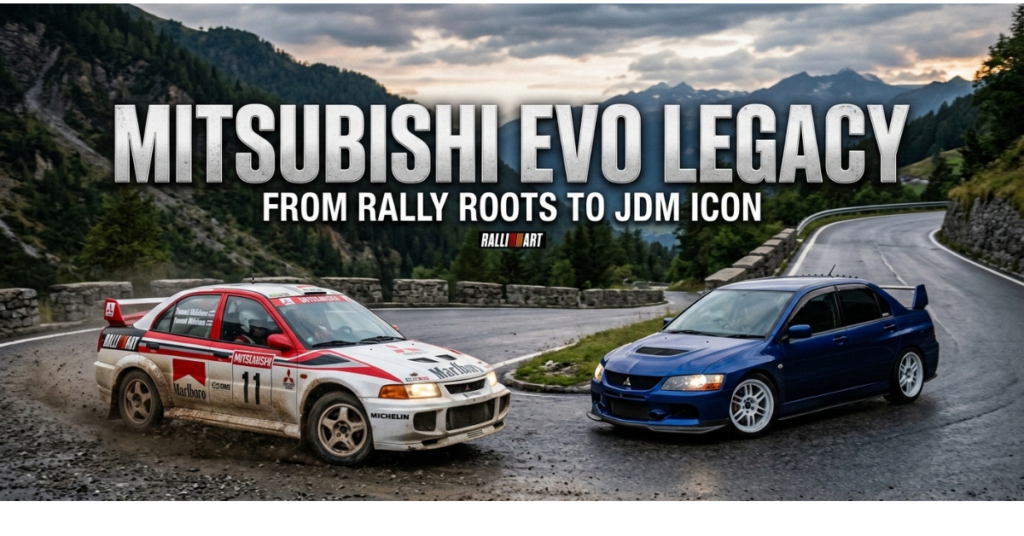

Few cars have earned the kind of respect the Mitsubishi Evo commands. Born from rally racing and refined for the street, this compact performance sedan became a global icon for speed, grip, and raw driving excitement. Whether you’re drawn to the classic aggression of the Mitsubishi Evo 6 or the modern engineering of the Mitsubishi Evo 10, the Evo story is one of passion, precision, and purpose.
In this guide, we’ll explore the full evolution of the Mitsubishi Evo lineup, highlight key generations, and explain why this car still dominates conversations among enthusiasts worldwide.
The Origins of the Mitsubishi Evo
The Mitsubishi Evo, short for Lancer Evolution, was originally built to satisfy World Rally Championship (WRC) homologation rules in the early 1990s. Mitsubishi needed a road-legal version of its rally car—and what they created exceeded all expectations.
Why the Evo Was Different
-
Turbocharged engines built for durability
-
Advanced all-wheel-drive systems
-
Lightweight chassis focused on handling
-
Race-proven engineering for everyday roads
From the start, the Evo wasn’t about luxury—it was about winning.
Evolution of a Legend: Key Mitsubishi Evo Generations
Each generation refined the formula while staying true to the Evo’s performance-first philosophy.
Mitsubishi Evo 4: A Turning Point
The Mitsubishi Evo 4 marked a major redesign and introduced the iconic 4G63 turbocharged engine with improved cooling and chassis balance.
Highlights:
-
276 hp turbocharged 2.0L engine
-
Introduction of Active Yaw Control (AYC)
-
Wider stance for improved grip
This generation laid the foundation for the Evo’s reputation as a corner-carving monster.
Mitsubishi Evo 5: Rally DNA on the Street
With a more aggressive body and enhanced aerodynamics, the Mitsubishi Evo 5 took performance to another level.
Key upgrades included:
-
Larger turbocharger
-
Strengthened suspension
-
Improved braking system
It was designed to dominate rally stages—and it felt just as confident on public roads.
Mitsubishi Evo 6: The Fan Favorite
Ask enthusiasts to name the most iconic Evo, and many will say the Mitsubishi Evo 6. It perfected the balance between power, handling, and driver engagement.
Why Evo 6 Is So Popular
-
Sharper steering response
-
Improved turbo efficiency
-
Legendary Tommi Mäkinen Edition (TME)
This version cemented the Evo’s place in automotive history and remains highly collectible today.
Mitsubishi Evo 7: A New Era Begins
The Mitsubishi Evo 7 transitioned to a larger platform, offering more interior space without sacrificing performance.
Notable changes:
-
New chassis shared with the Lancer Cedia
-
Refined AWD system
-
Better daily driving comfort
It appealed to drivers who wanted raw performance with improved usability.
Mitsubishi Evo 10: The Final Chapter
The Mitsubishi Evo 10 was a bold departure from tradition. It introduced a new engine and modern design while still delivering serious performance.
What Made Evo 10 Special
-
4B11T aluminum engine
-
Optional twin-clutch SST transmission
-
Advanced Super All-Wheel Control (S-AWC)
Though controversial at launch, the Evo 10 proved that evolution doesn’t mean losing character.
Performance That Still Competes Today
Even years after production ended, the Evo remains competitive thanks to:
-
Exceptional power-to-weight ratio
-
Tuning potential exceeding 500+ hp
-
Track-ready handling straight from the factory
Many Evos outperform modern sports cars at a fraction of the cost.
Why the Evo Still Matters
The Evo represents an era when manufacturers built cars for drivers—not algorithms. Its mechanical feel, turbo punch, and rally heritage are increasingly rare in today’s automotive world.
Reasons the Evo remains relevant:
-
Strong aftermarket support
-
Cult-like enthusiast community
-
Proven reliability under performance stress
Buying a Mitsubishi Evo Today: What to Know
If you’re considering owning one, keep these points in mind:
-
Check for heavy modifications
-
Review service and maintenance history
-
Inspect AWD and differential systems
-
Expect higher maintenance than average sedans
A well-maintained Evo is worth every effort.
FAQs About the Mitsubishi Evo
Is the Evo still being made?
No, ended production with the Evo 10 in 2016, making all Evos modern classics.
Which Evo is the best?
It depends on preference. Purists love the Evo 6, while modern drivers prefer the Evo 10 for daily usability.
Is the Evo reliable?
Yes—when properly maintained. Stock or lightly modified Evos are known for durability.
How much horsepower does a Evo have?
Most models came with around 276 hp, though real-world numbers were often higher.
Is the Evo better than the Subaru WRX STI?
This is a long-standing debate. The Evo typically offers sharper handling, while the STI focuses on mechanical feel.
Conclusion: The Mitsubishi Evo Legacy Lives On
The Mitsubishi Evo is more than a car—it’s a symbol of performance-driven engineering and rally-bred passion. From the raw aggression of the Mitsubishi Evo 4 to the refined power of the Mitsubishi Evo 10, every generation tells a story of innovation and speed.
If you’re a true driving enthusiast, the Evo isn’t just worth remembering—it’s worth experiencing.