
Parking on flat ground is easy. But parking on a hill? That’s where many drivers hesitate. Whether you’re a beginner learning for your driving exam or just trying to avoid your car rolling downhill, knowing how to park on a hill properly is an essential driving skill.
Many driving tests — including the Florida driving test — require you to demonstrate safe hill parking. If you do it incorrectly, your car could roll into traffic, damage property, or even cause injuries.
In this guide, you’ll learn exactly how to park on a hill with a curb, how to park on a hill without a curb, and the techniques examiners expect during a driving test. The steps are simple once you understand the logic behind them.
Why Learning How to Park on a Hill Matters
Hill parking isn’t just a driving test requirement — it’s a safety skill every driver needs.
When you park on an incline, gravity constantly tries to move your car. If the brakes fail or the parking brake slips, the vehicle could start rolling.
Proper hill parking techniques help:
-
Prevent your car from rolling into traffic
-
Protect pedestrians and other vehicles
-
Reduce pressure on your transmission
-
Pass your driving test hill parking requirement
Most driving manuals emphasize wheel direction and proper brake use, which we’ll cover below.
How to Park on a Hill With a Curb
Parking with a curb is the most common situation in cities. The goal is simple: use the curb as a safety barrier if the car begins rolling.
Follow these steps:
-
Slow down and signal
-
Always use your turn signal when preparing to park.
-
-
Pull close to the curb
-
Leave about 6–12 inches between your car and the curb.
-
-
Turn your wheels correctly
-
The direction depends on whether you’re facing uphill or downhill.
-
-
Shift into park (automatic) or first gear (manual)
-
Engage the parking brake
-
Turn off the engine
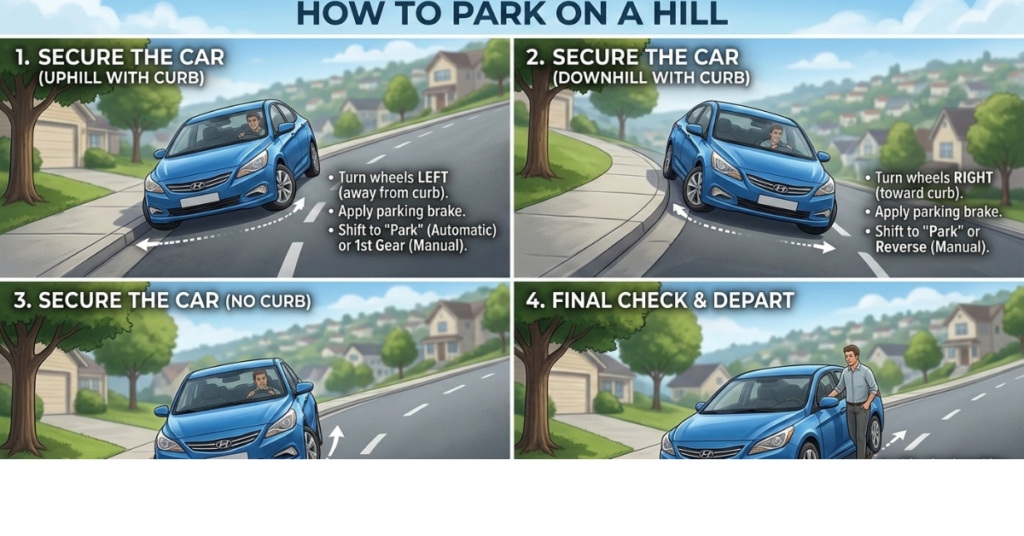
The wheel direction is the most important part — and the part most people get wrong.
Downhill Parking With a Curb
When parking downhill with a curb, turn your wheels toward the curb.
Why?
If your brakes fail, the car will roll forward and the front tire will hit the curb, stopping the vehicle.
Steps:
-
Turn steering wheel toward the curb
-
Shift to park
-
Apply parking brake
-
Let the car gently roll until the tire touches the curb
This is the standard technique taught in most driving schools.
Uphill Parking With a Curb
When parking uphill with a curb, turn your wheels away from the curb.
Why?
If the vehicle rolls backward, the back of the tire will hit the curb and stop the car.
Steps:
-
Turn steering wheel away from the curb
-
Put car in park
-
Apply parking brake
-
Let vehicle settle slightly against the curb
This creates a natural barrier preventing rollback.
How to Park on a Hill Without a Curb
When there’s no curb, the goal changes slightly. Instead of using the curb as a stop, you want the vehicle to roll away from the road if the brakes fail.
Steps for parking without a curb:
-
Pull over safely
-
Turn wheels toward the side of the road
-
Shift into park or first gear
-
Apply parking brake
-
Turn off engine
Wheel rule to remember:
-
Uphill without curb → turn wheels toward the road edge
-
Downhill without curb → turn wheels toward the road edge
This way, if the vehicle rolls, it moves off the road instead of into traffic.
How to Park on a Hill for a Driving Test
During a driving test, examiners check several things when you park on a hill.
They want to see that you:
-
Use your turn signal
-
Position the car close to the curb
-
Turn wheels correctly
-
Apply the parking brake
-
Put the car in park
-
Check surroundings before exiting
Common mistakes during the driving test
Avoid these common errors:
-
Forgetting to turn the wheels
-
Parking too far from the curb
-
Not using the parking brake
-
Rolling the car too aggressively
-
Forgetting to signal
Even small mistakes can cost points.
How to Park on a Hill: Florida Driving Test Rules
If you’re preparing for the Florida driving test, hill parking may appear during your exam depending on the location.
Florida driver examiners usually check that you:
-
Turn wheels correctly based on slope
-
Set the parking brake
-
Park within 12 inches of the curb
-
Demonstrate full control of the vehicle
Although Florida has fewer steep hills than other states, examiners still test this skill to ensure drivers understand vehicle safety principles.
You can review Florida’s official rules in the Florida Driver Handbook.
Quick Memory Trick for Hill Parking
Many instructors teach this simple rule:
“Downhill → Toward the curb
Uphill → Away from the curb”
If there is no curb, always turn the wheels toward the roadside.
This trick helps drivers remember the correct wheel direction during stressful situations like a driving exam.
Additional Hill Parking Safety Tips
A few extra habits can make hill parking even safer.
Best practices:
-
Always use your parking brake
-
Turn wheels before leaving the car
-
Avoid relying only on the transmission
-
Check mirrors before opening the door
-
Keep the car close to the curb
Drivers with manual transmissions should also leave the car in first gear (uphill) or reverse (downhill).
FAQs About Parking on a Hill
What direction do you turn your wheels when parking downhill?
Turn the wheels toward the curb. If the brakes fail, the tire will hit the curb and stop the car.
How do you park uphill with a curb?
Turn the wheels away from the curb, engage the parking brake, and shift the car into park.
How do you park on a hill without a curb?
Turn your wheels toward the side of the road so the vehicle rolls away from traffic if it moves.
Is hill parking required for the driving test?
Yes, many driving exams include hill parking techniques, especially knowledge of wheel direction and parking brake usage.
Do you need to use the parking brake on a hill?
Absolutely. The parking brake prevents pressure on your transmission and adds an extra layer of safety.
Conclusion
Learning how to park on a hill is one of the simplest ways to become a safer and more confident driver. By remembering a few basic rules — especially wheel direction, parking brake use, and proper positioning — you can prevent accidents and pass your driving test with ease.
Whether you’re practicing for the Florida driving test or simply improving everyday driving skills, hill parking is a technique worth mastering.